

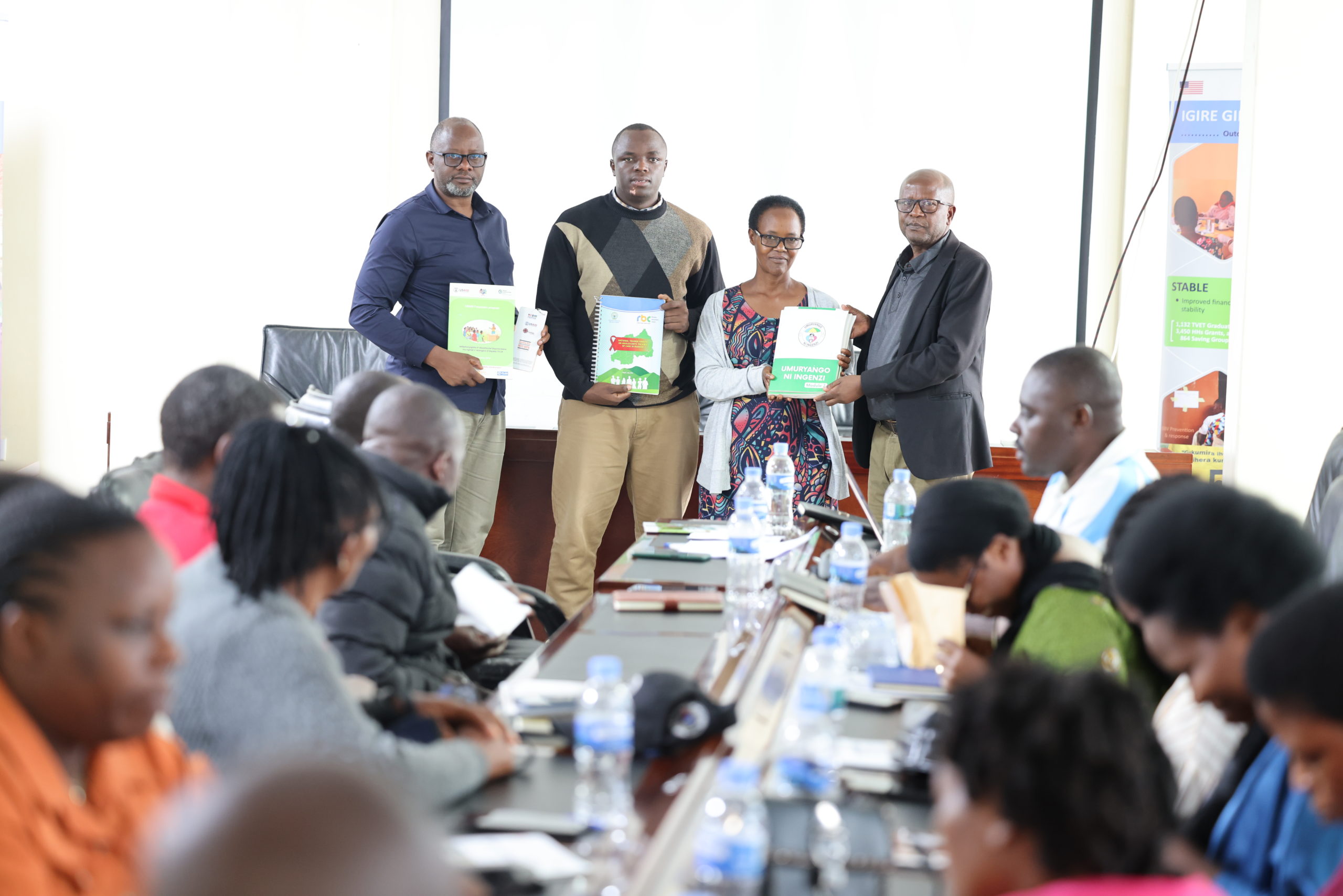
From 15 to 18 September 2026, Caritas Rwanda’s Igire-Gimbuka Program brought partners and stakeholders together across Rubavu, Nyamasheke, Karongi and Rutsiro Districts for a series of Transition and Learning Events held under the theme “Sustaining HIV outcomes through local ownership”, providing an opportunity to celebrate progress, share lessons and reflect on how to sustain HIV outcomes beyond the program close-out.
The first event was held in Rubavu District on 15th September 2026, followed by gatherings in Nyamasheke (September 16), Karongi and Rutsiro (September 18). Across the four districts, the events created a platform for partners and stakeholders to exchange experiences, highlight lessons learned and strengthen collaboration around the sustainability of HIV interventions.
Implemented from October 2022 to September 2026, the Igire-Gimbuka reached 68,299 children and caregivers with a range of services designed to address health, education, economic and protection needs.
Strengthening HIV health outcomes
Under the health component, 14,775 people were educated on HIV and linked to prevention services, including HIV testing.
The program also supported 11,912 people living with HIV, including 1,206 children and adolescents living with HIV aged 0–20, with adherence counselling, regular follow-up and psychosocial support.
Igire-Gimbuka also provided psychosocial support to children and adolescents living with HIV, people living with HIV and survivors of gender-based violence, while 25 adherence peer-support groups were strengthened and supported.
One of the notable health outcomes was the achievement of 98.5% viral load suppression, reflecting the importance of continued adherence support and follow-up for people living with HIV.
Supporting children to remain in school
Education was another important area of intervention. A total of 6,550 school-age orphans and vulnerable children (OVC) were supported and consistently monitored for school attendance and performance, achieving 100% regular attendance.
The program provided school fees to 1,121 learners, while all supported learners received essential scholastic materials, including school bags, pens and notebooks. Girls were also provided with sanitary pads to support them during menstruation.
These interventions helped address some of the barriers that can affect children’s participation and continuity in education.
Strengthening household economic resilience
Recognizing the link between household economic well-being and the ability of families to support children and maintain access to essential services, Igire-Gimbuka invested in economic strengthening.
A total of 260 participants received Technical and Vocational Education and Training (TVET) support, including six-month training fees and materials, three-month apprenticeships and start-up kits.
The program also provided grants to 899 households to strengthen income-generating activities, benefiting 4,875 household members.
In addition, 218 savings groups, comprising more than 6,275 members, received financial literacy support and were linked to financial institutions, including banks and microfinance institutions.
Among adolescents considered most at risk, including teen mothers, 327 received small-animal support valued at RWF 50,000 each to contribute to their economic strengthening.
Strengthening protection and safe environments
Igire-Gimbuka also focused on creating safer environments for children, adolescents and families.
A total of 890 survivors of gender-based violence (GBV) received psychosocial support services, while 153 teen mothers and their parents participated in GBV mobile clinics.
The program reached 1,453 caregivers with positive parenting messages aimed at improving child-parent communication, including 100 caregivers reached through FMP.
To strengthen community-based prevention and response, 613 IZU were trained on HIV prevention, child protection, GBV prevention, case reporting and first-line support to GBV survivors.
Meanwhile, 6,385 children aged 10–17 participated in preventive programs covering areas including sexual and reproductive health and rights (SRHR), CBIM and FMP.
From achievements to sustainability
The Transition and Learning Events held in Rubavu, Nyamasheke, Karongi and Rutsiro provided an opportunity for partners and stakeholders to look back on these achievements, share experiences and lessons learned, and discuss how to sustain the gains made.
District officials attending these meetings commended Caritas Rwanda for the achievements of the Igire-Gimbuka Program and urged the organization to keep the residents of their respective districts in mind when planning future projects.
As Igire-Gimbuka reaches the end of its implementation period, the transition process emphasizes the importance of local ownership, collaboration and locally led approaches in sustaining HIV outcomes.