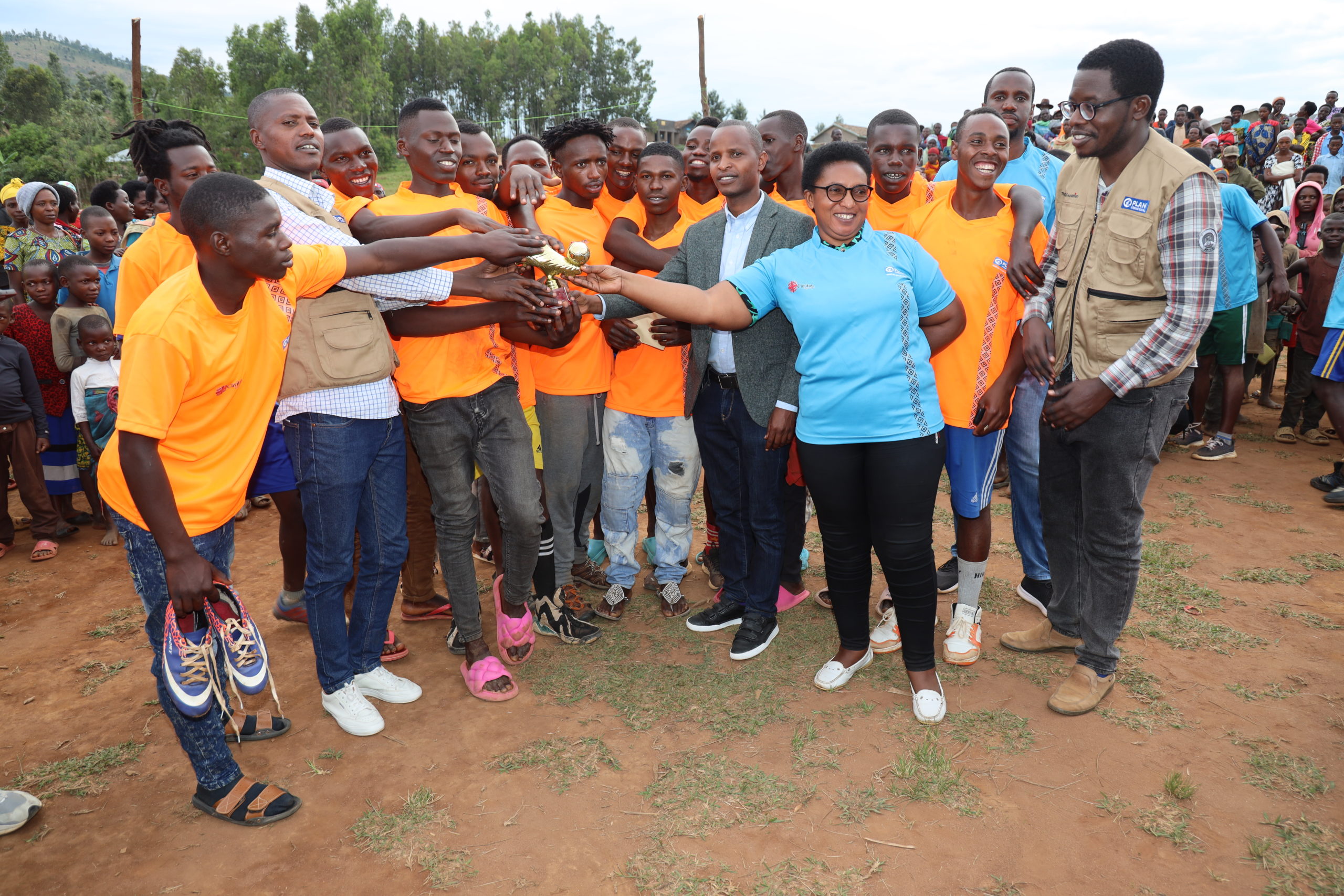
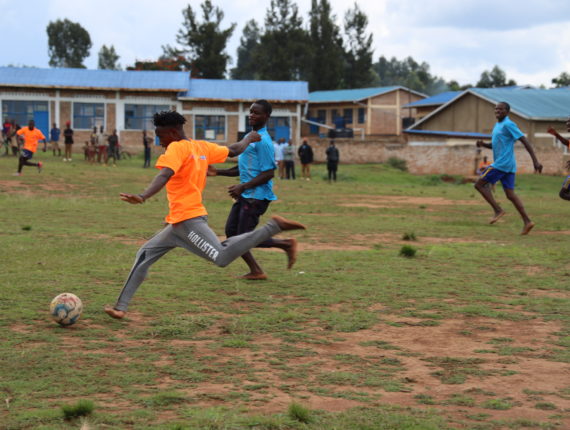
As part of its ECD project, funded by Plan Rwanda International, Caritas Rwanda organized a friendly football match between Rusenge Father Role Models and Gikunzi Father Role Models in Nyaruguru District. The Rusenge team scored 5 penalties against the Gikunzi team’s 4. This match was organized on March 18, 2025, to raise awareness among the parents on positive parenting focusing on the importance of fathers’ crucial role in the growth and development of their children.
Both teams scored one against one, which led to a penalty shootout.
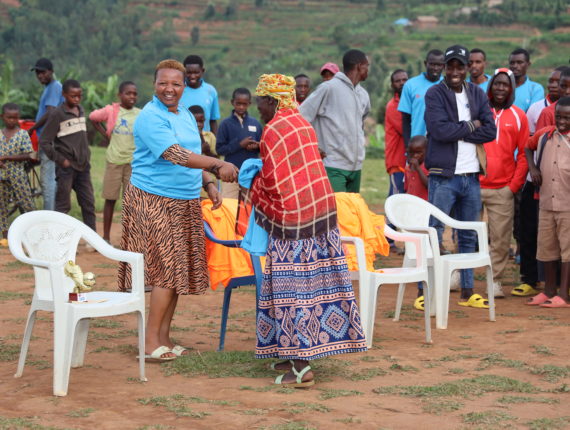
After the game, local leaders and project staff delivered messages and posed questions to underscore the crucial role fathers play in the growth and development of their children. The winning participants received t-shirts as a token of appreciation.
During this match, both teams scored the same one to one, which led to a penalty shootout. After the match, Nsabumuremyi Janvier, the Early Childhood Development (ECD) coordinator in Nyaruguru District, recalled the six pillars of ECD, namely: (i) adequate nutrition, (ii) health, (iii) water, sanitation and hygiene (WASH), (iv)child protection and inclusiveness, (v) readiness/ opportunities for early learning, and (vi) parenting education.
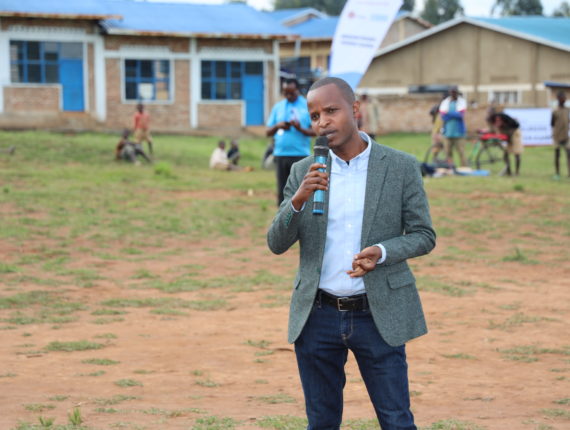
Janvier Nsabumuremyi, Nyaruguru District ECD coordinator, addressing participants.
Mr. Nsanzumuremyi took this opportunity to call on fathers to play a role as well as mothers in ensuring the implementation of these six pillars. He thanked Caritas Rwanda and Plan International Rwanda as donors involved in ECD activities in Nyaruguru District, including maintaining ECD centers and homes, providing various necessary equipment, training caregivers, and assisting parents in providing food for their children in HBECD and centers.
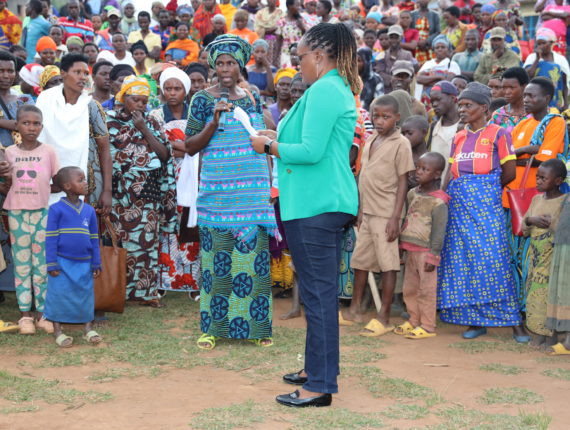
Question-and-answer session on the crucial role fathers play in the growth and development of their children.
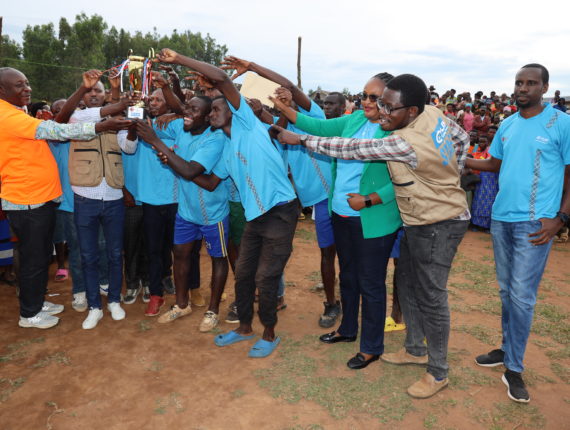
After the match, there was also a question-and-answer session on the crucial role fathers play in the growth and development of their children, and the winners received t-shirts as a token of appreciation. In addition, trophies were awarded to both teams, since the primary objective was to raise awareness about positive parenting, not to compete.
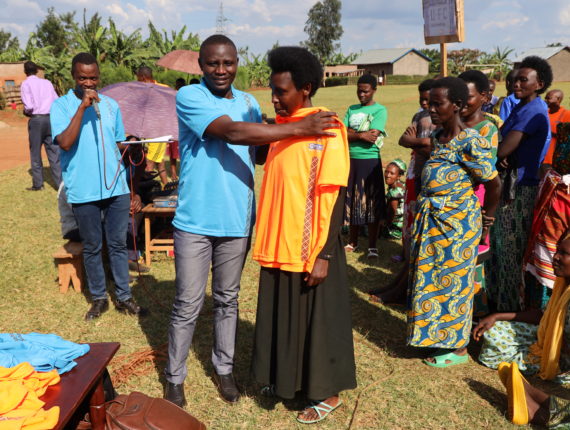
Distribution of t-shirts to winners of the question-and-answer session.
A similar event was also held in Gatsibo District on 14th March 2025, and is scheduled to take place in Bugesera District on 21st March 2025, the two districts where the ECD project is being implemented in addition to Nyaruguru District.
The winners of the game: Rusenge Father Role Models.
As a creative way to engage the community and spread awareness on Positive Parenting, Caritas Rwanda in partnership with Gatsibo District, through the Early Childhood Development (ECD) Project funded by Plan International Rwanda, organized a football match between Murambi and Kiziguro Father Role Models. This event was held at Groupe Scholaire Rwimitereri, Murambi Sector in Gatsibo District on March 14, 2025.
The specific goals of this awareness campaign were to:
– Promote parental involvement, with a particular emphasis on fathers, in nurturing care tasks, gender transformative emphasizing the significance of shared responsibilities within the family unit;
– Use football as a means of fostering positive interactions between parents and their children;
– Establish a forum for fathers to gain experiences from father role models, enhancing parenting skills;
– Educate communities on the transformative impact of positive parenting practices in cultivating responsible children and how such practices can mitigate issues such as school dropouts, domestic violence and behaviour problems in the future.
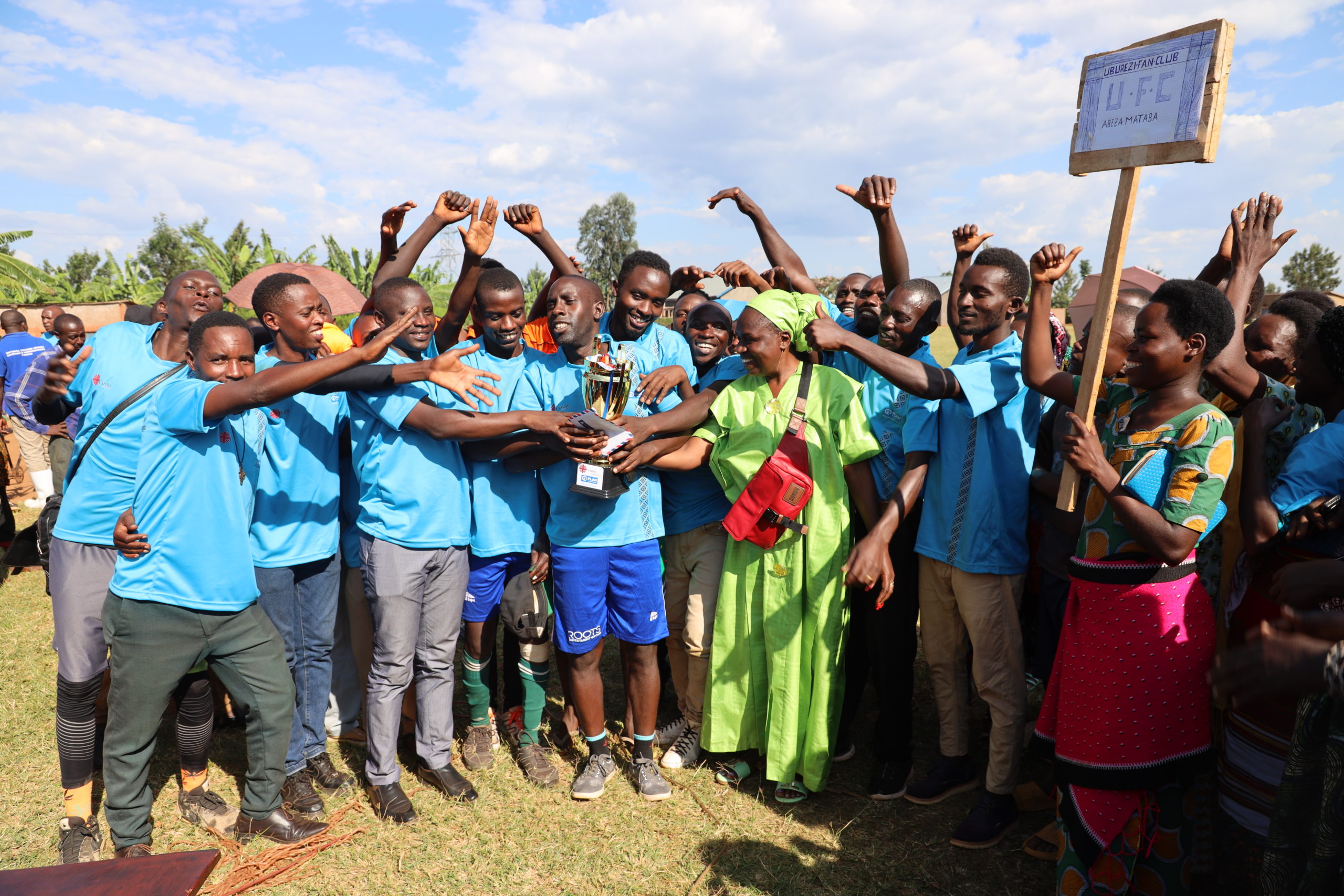
In this community awareness promoting Positive Parenting, the Murambi Father Role Models team emerged victorious with a score of 5 against 0 of the Kiziguro team. The two teams received trophy cups each.
During the half-time, local leaders and project staff delivered messages highlighting the crucial role fathers play in the growth and development of their children. Following the messages, a question-and-answer session took place, and t-shirts were awarded to the winning participants.
During the question and answer session, the winners received the t-shirts as a prize.
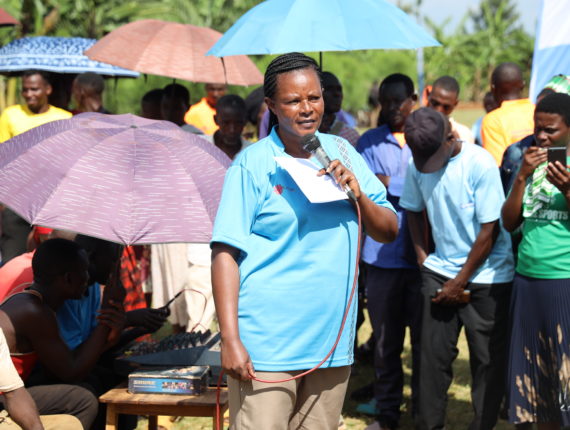
Addressing participants, Naomy Mukagasana, the Gatsibo District employee in charge of Gender and Family Promotion, urged parents (both fathers and mothers) to take care of their children by giving them love, raising them in a proper manner and setting boundaries for what is and is not allowed, building their self-confidence, protecting them from the harm of technology and being loving parents to be a role model for them.
Naomy Mukagasana, the Gatsibo District employee in charge of Gender and Family Promotion.
This awareness campaign will also be carried out in Nyaruguru on 18th March 2025 and in Bugesera on 21st March 2025.
Caritas Rwanda Family, gathering 10 diocesan Caritas and National level joined in a two-day reporting workshop on January 23-24, 2025, at Centre d’Accueil Bonne Esperance Kicukiro, in a preparation of the forthcoming General Assembly of Caritas Rwanda scheduled March 25-26, 2025. The workshop was characterized by the commitment and active participation of all members of the network as testified by Head of Administration and Finance department, Head of Health Department, Social Welfare and Development Departments’ Representatives in their feedback remarks.
Closing the session, Father Oscar KAGIMBURA, Secretary General of Caritas Rwanda expressed his gratitude to all participants. “Getting well prepared will allow shortening the Geneal Assembly from two days to one in the future”, he said. The departments were reminded to keep joining hands in mobilizing more resources, maintaining existing and new partners satisfied through clear and transparent communication, creating more and more trust.
The new Caritas Rwanda Strategic Plan 2025-2030 will allow us to continue supporting those in need to improve their lives. Father Oscar stressed the importance of being always ready to intervene in case of emergencies and reminded participants of the pending approval of the “Preparedness Plan” inviting concerned persons to work on it as quick as possible. “This is the work of all Caritas departments as emergencies affect all your plans”, said the Secretary General. Participants were reminded of supporting Rwandans to achieve their integral development through informing them of existing opportunities, supporting them to access services they offer among others. Departments were mandated to synergize with other Episcopal Conference Commissions and Services, development should explore ways to support Catholic Church decentralized resources to significantly contribute to the increase of agricultural and animal production towards food security and access to food, leveraging existing warehouses and other postharvest processing infrastructures.
On 9th January 2024, Caritas Rwanda in collaboration with the Burera District officially inaugurated the Rwabageni Nurturing Care Hub, constructed with funds from the Dennis and Jane Reese Foundation, in Kiringa Cell, Kagogo Sector, Burera District in the Western Province of Rwanda. This NCH will help 80 children access early childhood education at village level.
Apart from fostering early childhood education, the Rwabageni NCH will serve as one stop site for community nutrition interventions supported by USAID Gikuriro Kuri Bose program to fight against stunting among young children.
During the Rwabageni NCH inauguration, the guests visited two classrooms of Children aged (3-4 years) and (5-6 years) and observed how the community with the USAID Gikuriro Kuri Bose support is improving Early learning, Positive parenting education, Child Play and stimulation, and disability inclusion.
Guests visiting the 5-6 years classroom and singing with them.
Father Oscar Kagimbura, the Secretary General of Caritas Rwanda expressed their gratitude to the Dennis and Jane Reese Foundation for funding the Rwabageni NCH initiative and urged parents to take ownership of the NCH to ensure its sustainability.
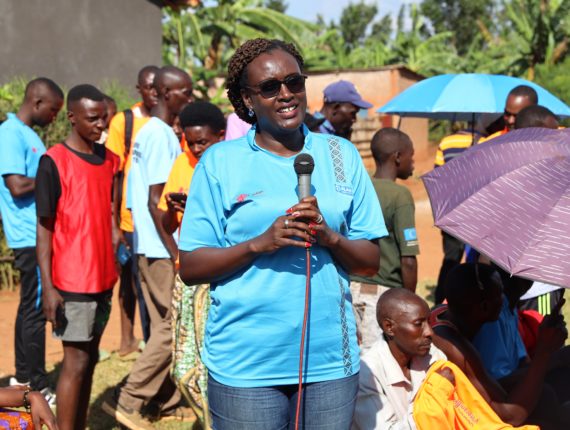
As for Mrs. Mukamana Soline, Mayor of Burera District, the Rwabageni NCH initiative falls within the national Early Childhood Development (ECD) strategy, which attempts to promote children’s development from conception to age six. “As local leaders, we prefer sustainable initiatives rather than those that end with projects,” said Mayor Mukamana Soline.
Aron James, representing the Dennis and Jane Reese Foundation in the ceremony, thanked local authorities for their cooperation and expressed his delight in seeing parents actively participating in NCH activities. He also pledged continued collaboration to support the initiative.
Aron James, who represented the Dennis and Jane Reese Foundation in the Rwabageni NCH official inauguration.
This event was also a good opportunity to raise awareness on fighting against the stunting among young children. In her speech, Dr. Umurungi Serubibi Yvonne, Chief of Party for the USAID Gikuriro Kuri Bose Program, reminded the participating mothers that they must conducted 8 ANC standard visits during pregnancy, breastfeed their children for 6 months without any supplements, and after 6 months, start giving them a balanced diet as instructed.
During the inauguration, the children were provided with nutritious meal.
In order to reflect on the past year, meditate and prepare for the Christmas day, Caritas Rwanda staff participated in a one-day retreat (December 24, 2024) at the Saint Vincent Palotti Center Gikondo.
Caritas Rwanda hosts this kind of retreat annually, which unites all staff members-both those at the headquarters and those working in different parts of the country. This retreat consists of a number of activities, such as hearing the sermon for the day, exposition of the Blessed Sacrament, adoration, penance and meditation, Holy Mass, and meal sharing.
Father Emmanuel Nsengiyumva delivered the sermon.
Father Emmanuel Nsengiyumva urged the retreat attendees in his sermon to always consider why they work for Caritas Rwanda, why God has selected them for this work, and what will enable them to carry out their tasks effectively. “We become servants to everyone to whom we are given in order to serve them. You have to serve them and humble yourself as you become promoted. It is crucial to carry out these responsibilities effectively, and you will be rewarded for your efforts,” Father Emmanuel added.
Father Oscar Kagimbura, the Secretary General of Caritas Rwanda.
At the conclusion of the retreat, Caritas Rwanda Secretary General Father Oscar Kagimbura thanked Father Emmanuel Nsengiyumva for his sermon, which reminded Caritas Rwanda staff that they play a crucial part in sharing God’s love by engaging in acts of compassion for those in need. “By appropriately carrying out our duties, we demonstrate this love. People show their appreciation for Caritas Rwanda’s work. This retreat is an opportunity to thank all the employees involved in the various activities of Caritas Rwanda”, continued Father Oscar who also used the opportunity to wish all of the personnel a Merry Christmas and a Happy New Year 2025.
The Graduation Project that has been implementing in Mahama, Nyabiheke and Kiziba Refugee camps and their host communities; as well as in Kigali urban was concluded on 11th December 2024 at Nobleza Hotel Kicukiro.
During its 5-year lifetime, the Graduation Project supported 3,017 households. The participants benefited from various training sessions and received cash grants of Rwf 800,000 each to start income-generating activities towards their self-reliance. 3,017 businesses were established, resulting in the creation of 4,987 jobs. 8 cooperatives were formed as well, to enhance collective economic activities.
In his opening remarks, Father Oscar Kagimbura, the Secretary General of Caritas Rwanda commended various participants for their contribution in the project achievements, especially in improving lives of refugees and host communities.
Father Oscar Kagimbura, the Secretary General of Caritas Rwanda, delivering the opening remarks.
During this event, the Graduation Project participants delivered touching testimonies demonstrating how they became empowered and self-reliant, thanks to this project’s support. In a gallery walk, they exposed and gave more explanations to guests regarding their income generating activities.
Some of the Graduation participants shared touching testimonies with the guests.
The Danemark Mission in Rwanda’s representative in the ceremony, Karangwa Viateur, stressed that after visiting the projects participants’ income-generating activities, they noticed that there are so many people who need help that one donor cannot support alone. He called on various donors to get engaged so that they can form a coalition and help people in need. In fact, the Danemark mission has approved the second phase of the Graduation project basing on its first phase achievements.
Karangwa Viateur, who represented the Danish Mission in Rwanda at the ceremony, called on various donors to form a coalition so that they can form a coalition and help those in need.
Mrs. Richelle Haines, who spoke on behalf of the UNHCR Rwanda at the Graduation Project closeout ceremony, commended the Rwanda Government for receiving the refugees and giving them opportunities to develop. Mrs. Haines emphasized that the Graduation project has provided lessons on empowering refugees towards self-reliance.
Mrs. Richelle Haines, who spoke on behalf of the UNHCR Rwanda at the Graduation Project closeout ceremony, commended the Rwanda Government for receiving the refugees and giving them opportunities to develop.
As for Mr. Karabayinga Emmanuel, the guest of honour in the ceremony and representing the Rwanda Ministry of Emergency Management commended Caritas Rwanda for successfully implementing a project aligned with the Rwanda’s 2016 leaders’ summit commitment to promoting livelihoods for refugees. As a result of the summit, the strategy was launched by MINEMA and UNHCR aiming to transition refugees from dependency to self-reliance alongside host communities. He also thanked donors for their support and congratulated participants on their five-year journey toward self-reliance.
Mr. Karabayinga Emmanuel, representing the MINEMA in the ceremony thanked donors for their support and congratulated participants on their five-year journey toward self-reliance.
The Graduation project closeout ceremony was also an occasion to share the lessons learned and the way forward through a panel discussion formed by camp managers, mayors, refugees’ representatives and Caritas Rwanda’s staff.
The Graduation Project is funded by the Government of Denmark through the United Nations High Commissioner for Refugees (UNHCR). Over a five-year period (2020-2024), it has cost $3,066,640 USD (around Rwf 4,250,000,000). It aims to promote economic inclusion and self-reliance of refugees and their host communities in Rwanda (with a target of 3017 households). Furthermore, the Denmark government had agreed to provide funding for the Graduation second phase.
As part of the 2024 World AIDS Day celebrations, a delegation from USAID Rwanda, UN Rwanda, and RBC Rwanda paid a high-level site visit to Caritas Rwanda’s Igire Gimbuka in Rubavu District, 2024. This visit aimed to highlight the program’s accomplishments in reducing the risk of HIV/AIDS, reducing gender-based violence, and providing comprehensive services to people living with and at risk of HIV/AIDS.
The delegates interacted with participants of the Families Matter! Program who shared touching testimonies on how their families’ lives have improved thanks to the FMP training. Some testified about how their families no longer have conflicts; others said that the positive parenting has impacted the education and the relationship with their children. Thanks to the FMP program, parents discuss sexual and reproductive health with their children, while others cascade the knowledge gained from the FMP training sessions to their neighbors and relatives, which has also changed their lives.
The team also paid a visit to the Duharaniramahoro Savings Group, which raises and sells chickens as a sustainable income-generating activity. The group that consists of 15 members (13 women and 2 men) was created in 2023 and received a grant of USD 679 from Igire-Gimbuka to enhance their financial capacity. The business generates at least Frw 250,000 profit per month depend on market.
Duharaniramahoro saving group members shared how the group strengthened their economic resilience through internal credits, and therefore improved their health and nutrition, enhanced social cohesion and well-being, and enabled them to meet household needs such as food and medication (all of them have community-based health insurance) and contributing to Ejo Heza.
The USAID representative, Esron Niyonsaba, thanked other partners who support the Igire-Gimbuka’s implementation and revealed that USAID is planning to graduate all participants who receive financial support, and by 2030, the way aid is provided will be changed.
During the meeting with FMP participants, the guests asked questions, including knowing the content of FMP training and how benefiting families are identified, as well as knowing whether those who attended FMP trainings disseminate the knowledge they received. They were told that FMP training consists of 7 lessons focusing on promoting positive parenting practices, enhancing parent-child communication about SRH and other life skills, encouraging delayed sexual activity among adolescents, and addressing risky behaviours such as early pregnancies and HIV/STI contamination.
The delegates were also informed that Caritas Rwanda works closely with local leaders to identify families that will follow the FMP Program and that the FMP participants share the gained knowledge with the community, starting with their relatives and neighbours.
Keisha Effiom, the Mission Director for USAID Rwanda and Burundi.
In her speech, Keisha Effiom, the Mission Director for USAID Rwanda and Burundi, introduced the background of the USAID OVC program implementation in Rwanda and added that the site visit shows how the OVC program has invested in families and communities: the Families Matter Program helps to reduce family conflicts, improve relationships between parents and children, and build cohesion among group members. This has allowed them to even discuss sensitive topics, like sex. She mentioned that these achievements are a good foundation for informing the multisectoral approach are represented. “Thank you for your partnership, dedication, and shared commitment. Let us work together to ensure a brighter future for our children, families, and communities in Rwanda”, she said.
Mrs. Pacifique Ishimwe, the Vice Mayor of Rubavu District in charge of Social Affairs, commended the FMP program because the participants also shared the benefits they gained from this program with the community. She urged them to spread this knowledge wherever they are, especially during these 16 days of activism against gender-based violence.
To conclude, Bishop Anaclet Mwumvaneza of Nyundo Diocese expressed his sincere gratitude to USAID for the trust it has placed in Caritas Rwanda since 2012 in its journey to care for orphans and vulnerable children and to care for other Rwandans’ health in general. Bishop Anaclet also appreciated the partnership between Caritas Rwanda and the Government of Rwanda in implementing various projects. “If we continue this way, we will reach many vulnerable people and change their lives in a positive manner,” said Bishop Anaclet.
On the previous day (December 1, 2024), Caritas Rwanda participated in the celebration of the World AIDS Day 2024 at national level in Rubavu District. Caritas Rwanda though the Igire Gimbuka showcased its work in reducing vulnerability and preventing the incidence of HIV and GBV among OVC and their families. This year’s theme is “Ends AIDS, my responsability”.
On 27th November 2024, at Sainte Famille Hotel, Caritas Rwanda hosted its 2024 Partners Forum, a premier event that brought together key stakeholders in social welfare, health and development sectors. This Partners Forum showcased the achievements of Caritas Rwanda’s 2020-2024 Strategic Plan and outlined orientations for the upcoming 2025-2030 Strategic Plan.
The Partners Forum was also an occasion to express gratitude for current and future partnerships, and strengthen “Partner Engagement” across planning, program design, implementation, monitoring, and evaluation.
During this event, the stakeholders engaged directly with Caritas Rwanda projects and program participants through interactive gallery walks, where some of them were exhibiting they income activities.
The guests discussed with the Caritas Rwanda’s programs / projects participants who showcased their income generating activities.
One of the Caritas Rwanda’s programs/projects, Kwibuka Sostène from Nyamasheke District, testified how Caritas Rwanda through the Igire Gimbuka program supported him to accomplish a TVET program in carpentry and providef him with toolkit. With a small amout of money gained in his first job and the toolkit, he created his own workshop. Today, he earns at least Rwf 70,000 and has managed to buy a plot of land at Rwf 500,000 and started a pig farming.
Mrs. Claudine Nyinawagaga, the Director General of the Local Administrative Entities Development Agency (LODA), in her speech, commended Caritas for its work in supporting the government fight poverty, and recommended the organization to work in close collaboration with local authorities at any level.
Mrs. Claudine Nyinawagaga, the Director General of the Local Administrative Entities Development Agency (LODA), in her speech, commended Caritas for its work in supporting the government fight poverty.
To react to this recommendation, Bishop Anaclet Mwumvaneza of the Nyundo Diocese and the President of Caritas Rwanda, said that Caritas already works with local authorities, giving an example of how local leadership participate in participants identification, especially those who have not yet received other support. “We will continue to find new ways to reach more vulnerable people”, said Bishop Anaclet.
Bishop Anaclet Mwumvaneza of the Nyundo Diocese and the President of Caritas Rwanda, said that local leadership participate in the identification of programs / projects participants.
Hans Fly, the Catholic Relief Services Rwanda Country Representative who spoke on behalf of other partners, said that the reason why Caritas Rwanda gathered them on this day is because it values partnership across diverse partners either be Government, public sector, in national civil society, Church and so on. Caritas search solidarity in its mission. “What is the uniqueness, what Caritas brings to the table? It is its mission, which is also ours, to serve most vulnerable people and leave no one behind. After seeing all those achievements, I think Caritas Rwanda is a strong example of localization”, added Mr. Fly.
Hans Fly, the CRS Rwanda Country Representative.
The Caritas Africa’s representative, Bishop Pierre Cibambo Ntakobajira, who attended the ceremony, congratulated Caritas Rwanda for what was done during the last five years, and qualified the organization as a good example in accomplishing the Catholic Church mission of assisting vulnerable people. “The work of Caritas is not a job but a mission to restore hope to the needy”, Bishop Cibamba added.
The Caritas Africa’s representative, Bishop Pierre Cibambo Ntakobajira, attended the ceremony.
During the Partners Forum, Philippe Habinshuti, the Permanent Secretary for the Ministry in Charge of Emergency Management (MINEMA) stressed that the Catholic Church through Caritas has been a pillar of strength and hope for countless individuals in Rwanda. “Your tireless dedication to the welfare of vulnerable people being citizens or refugees, your continuous assistance to people affected by social-economic shocks and disasters is remarkable. We recognize the contribution of Caritas at Diocesan Caritas and Parish levels but also the valuable contributions of Christians whenever their neighbours’ needs are affected”, PS Philippe Habinshuti added.
Mr. Philippe Habinshuti, the Permanent Secretary at the Ministry in charge of Emergency Management (MINEMA) stressed that the Catholic Church through Caritas has always been a pillar of strength and hope for countless people in Rwanda.
In this event, attendees included leaders from the Catholic Church, representatives from international organizations, national and local government officials, Caritas sisters, members of local organizations, private sector partners, universities, and higher education institutions, as well as program participants and volunteers.
As part of its commitment to fostering inclusive growth and development, USAID Gikuriro Kuri Bose proudly collaborated with local government authorities to mark the International Day of Persons with Disabilities and the support this year has been pivotal in making the day a success. This year’s celebration shone a spotlight on empowering individuals with disabilities and creating sustainable opportunities for their families. The event served as a platform to raise awareness of the rights and contributions of persons with disabilities while also addressing the barriers they face in society.
Collaborating for Change: USAID Gikuriro Kuri Bose Leads CBID Approach for Disability Integration
By incorporating inclusive principles into nutrition and ECD programs, USAID Gikuriro Kuri Bose has enabled better access to health, education, and nutritional support for children and adults with disabilities. The training sessions and resources provided to 1,533 CBID Volunteers in Burera, Rulindo and Nyabihu as well as to local governments, community leaders, and stakeholders have strengthened their capacity to implement inclusive strategies effectively. This has bridged gaps in service delivery and promoted equity at the community level. Communities are progressively taking ownership of inclusive programs, reinforcing long-term impacts on growth and development.
Promoting Health Equity: USAID Gikuriro Kuri Bose Ensures Vulnerable persons with Disability Receive Specialized Medical Care
USAID Gikuriro Kuri Bose collaborates with health facilities and medical professionals to facilitate access to specialized medical care for individuals with disabilities. The facilitation includes financial assistance, facilitating transport to medical facilities, and connecting families with specialize health facilities.
These efforts have allowed 180 person with disability including children and adults to receive essential therapies, assistive devices, and interventions that enhance their well-being and integration into the community in Burera, Rulindo and Nyabihu where Caritas Rwanda implements USAID Gikuriro Kuri Bose.
Mukakabera Beltrilde, the mother of a child born with clubfoot in Rulindo District and supported to undergo corrective surgeries and fitted with custom-made orthopedic shoes attested:“Before the support, accessing specialized care for my child felt impossible. Now, my child is not only receiving treatment but also thriving in school and life.”
By working collaboratively with healthcare providers, communities, and stakeholders, USAID Gikuriro Kuri Bose aims to break down the barriers that prevent individuals with disabilities from living fulfilling, independent lives.
Building Financial Resilience for Persons with Disabilities: Direct Cash Support and Savings Groups in Action
Through direct cash support that reached 1326 selected vulnerable families with persons with disabilities in Rulindo, Burera and Nyabihu and the establishment of savings groups, USAID Gikuriro Kuri Bose is making significant strides in advancing the economic empowerment of persons with disabilities. The direct cash support enables beneficiaries to invest in small income generating activities that will contribute to their long-term financial independence. By removing some of the barriers related to poverty, the initiative offers recipients a sense of dignity and self-worth, enabling them to engage more fully in their communities and participate in economic activities.
A Call to Action
While reflecting on this year’s celebration theme “Amplifying the leadership of persons with disabilities for an inclusive and sustainable future”, USAID Gikuriro Kuri Bose reaffirms its commitment to building inclusive and empowered communities, calling on stakeholders to join hands in ensuring that persons with disabilities, particularly children, are provided with equal opportunities to thrive. Together, we can create a world that truly leaves no one behind. Let us celebrate diversity and take actionable steps toward inclusivity every day of the year!
World Savings Day, celebrated globally on 31 October, emphasizes the importance of saving and financial literacy for individuals and communities alike. In Rwandan rural areas like Nyabihu, Burera, and Rulindo, where access to financial services is limited, SILC groups are crucial for improving household nutrition and building economic resilience. In honor of this day, USAID Gikuriro Kuri Bose Program has provided financial and technical support to highlight and strengthen the role of rural savings groups in promoting better nutrition and overall well-being.
Small Savings, Big Impact: Savings Groups as Catalysts for Better Nutrition and Community Resilience
In rural communities, SILC groups established with the support by USAID GKB are instrumental in creating access to funds that allow families to make small but vital investments in their nutrition and overall health. Members pool their savings, giving each member an opportunity to borrow, invest in nutritious food, and pay for essential health and childcare expenses. By enhancing financial resilience, SILC groups help ensure that families have access to nutritious food year-round, which is especially critical in times of economic downturns.
USAID Gikuriro Kuri Bose Support in Action
In partnership with local leaders and relevant stakeholders, USAID Gikuriro Kuri Bose provides both financial and technical support through capacity building of groups’ leaders and members in financial literacy guiding group members in efficient savings practices, budgeting, and investing in nutrition oriented income-generating activities while connecting groups with market opportunities. This combination of financial and technical assistance amplifies the group’s impact on local food systems, allowing them to grow nutrient-rich foods and further improve household nutrition.
Celebrating Success and Looking Forward
This year, USAID Gikuriro Kuri Bose program’s contribution to World Savings Day highlights the success stories from several SILC groups that have transformed their communities through financial empowerment and enhanced nutrition. By celebrating their achievements, we hope to inspire further commitment to sustainable food systems, financial resilience, and child-focused health and development initiatives. The impact of rural savings groups goes beyond financial savings. Moving forward, USAID Gikuriro Kuri Bose remains committed to supporting these groups with resources and training that amplify their positive impact on health and nutrition. This World Savings Day, we celebrate the transformative role of savings groups and look forward to continued collaboration for a healthier, more prosperous future.




 By incorporating inclusive principles into nutrition and ECD programs, USAID Gikuriro Kuri Bose has enabled better access to health, education, and nutritional support for children and adults with disabilities. The training sessions and resources provided to 1,533 CBID Volunteers in Burera, Rulindo and Nyabihu as well as to local governments, community leaders, and stakeholders have strengthened their capacity to implement inclusive strategies effectively. This has bridged gaps in service delivery and promoted equity at the community level. Communities are progressively taking ownership of inclusive programs, reinforcing long-term impacts on growth and development.
 These efforts have allowed 180 person with disability including children and adults to receive essential therapies, assistive devices, and interventions that enhance their well-being and integration into the community in Burera, Rulindo and Nyabihu where Caritas Rwanda implements USAID Gikuriro Kuri Bose.
